Sunday, February 15, 2009

Groupthink in the danish patent office.

...or maybe rather "how to prevent groupthink in the danish patent office".

As part of taking an interest in Free Software I take an interest in the much broader field of the "government regulated limited monopoly privileges" that are most famously found in copyright, patents and trademarks. The danish patent office happens to be a front runner in blogging among danish governmental and semi-governmental institutions, and I naturally follow their blog.

While following the blog I have had a feeling that something isn't quite right about the tone and angle of the posts. But only recently have I been able to put my finger on what is wrong.

As the patent office is part of the danish ministry of commerce, I guess I expected the employees to somehow have a philosophy of serving the citizens of Denmark. They may even expect that too, but in practice the only perspective they seem to take is that of businesses. And the only laws and rules they seem to care about are those that benefit businesses.

Recently this was put on a point by a post announcing the yearly conference of the patent office which was addressed to "IP professionals" and in which the poster claimed "it is important to us to hear the thoughts of [our] customers and industry on what you think are the biggest challenges in the future of IP".

This echoed with an article about an american conference about software patents in which the basic division in opinion about software patents was: the lawyers were for software patents, and technologists and economists were against. And the author of that article quite reasonably proposed that patent lawyers have a different world-view because of who they interact with.

"Patent attorneys only interact with those parts of the software industry that participate in the patent system. When software engineers write useful software without seeking patents on it — a vastly more common occurrence — patent attorneys will, by definition, not be there. Therefore, patent lawyers are inevitably going to over-estimate the importance of patents to the software industry."

The same can very well apply to the danish patent office. If they only meet with patent holders or patent seekers in their daily work they will only be exposed to one single point of view on patents. Now if they hold conferences and explicitly ask for the same type of people (with the same type of views) to attend it seems to me that they miss a chance to fulfill the role I, at least, imagine is suitable for a government institution.

I asked if the patent office has any strategies to reach out and get opinions from sources other than "industry and customers" but got the answer "we have to prioritize our resources". I don't think this is a reasonable answer. The patent office is not just an administrator of rules. It has important impact on setting opinions and policies on trademarks, patents and related subjects (example). And in my opinion it therefore has a large obligation to keep policies and opinions balanced in favor of citizens. If the working conditions of interacting much with industry makes this difficult (as it must), the patent office has a double obligation to counteract the tendency to industry-group-think. I hope they will honor that obligation.

Sunday, January 25, 2009

2009 New Years resolutions

I partially met my 2008 resolutions. I guess one of my ideas with these resolutions is to aim for something doable, that I will none the less have to put in some effort to succeed with. What do I want to aim for in 2009.

  • Do more blog posts than in 2008. (shouldn't be too hard)
  • Blog about science, economics, politics and the environment.
  • Spend some of my money to make the world a better place (I already joined "The Danish Society for Nature Conservation" - do more like that)
  • Try the Free Software Foundation Europe goals for 2009 - I think I can easily manage the first three points.
  • Prepare better and run a full half marathon.
  • Write more than 1000 lines of code in a new programming language (new meaning a language that I haven't written more than 1000 lines of code in before). I am guessing it will be Groovy or JavaScript.
Actually I also want to visit the dentist more and to buy one of those fancy new Solid State Disk drives that Linus Torvals seems to like (update). But it doesn't quite sound fancy enough to make the list.

Friday, January 23, 2009

2008 New Years resolutions status

Early last year I blogged my new years resolutions here. And before I blog any new resolutions for 2009 I might as well look back at how I did with the ones for 2008. Here goes

  • Blog at least a couple of times per month (preferably once per week) - With 38 posts in 2008 I am slightly over "a couple of times per month" but under "once per week". WIN
  • Run ca. 10 km once per week (in preparation for a half marathon in May) - Much of the year I actually accomplished a ~10km run per week, and I did go to the half marathon. Not with complete success as my knee hurt after 16 km and I walked some kilometers after that. WIN
  • Get to work around 9 am instead of 10 am. Hmm, no great success with that. FAIL
  • Participate in Open Science. No success here either. I left science in the summer, and I never worked on my project in the open. FAIL

Maybe I'll do better this year.

Sunday, January 18, 2009

How we can do much better than extending copyright

The american Mickey Mouse Protection Act is coming to Europe...and the OpenRightsGroup have made a short film on what is wrong about that, how it will hurt consumers (like me, and probably also you - anyone who is not a record company executive). Fortunately it also mentions what we could do instead of extending copyright.


The association of danish newspaper publishers have also voiced a well argued and strongly negative view on extending copyright for recordings.

Thursday, December 04, 2008

Introducing FriendFeed

I read quite a lot of blogs, and I do so easily and efficiently with google reader. And google reader also automatically tells me what people I know "share" in their google reader. This is great, I click "share" on blog posts I really like and others do the same. However, even though I know a lot of smart people, only few of them seem to use google reader, and they don't all use the "share" button that much.

Fortunately for me, I have found a way to follow the "sharings" of a lot of smart people who share links and post on FriendFeed. And even more, I can also follow the discussions they have about the links and posts (and participate). I follow a bunch of individual people and I follow some "rooms" where people share stuff with a common theme. Eg.


This is one step up from blogs in sophistication, I think.

Tuesday, November 04, 2008

Yes they can. Today we are all american.


We were told they cannot do this by a chorus of cynics. And they only grew louder and more dissonant in the weeks and months that came.

We've been asked to pause for a reality check. We've been warned against offering the people of that nation false hope. But in the unlikely story that is America, there has never been anything false about hope.


For when we have faced down impossible odds, when we've been told we're not ready or that we shouldn't try or that we can't, generations of Americans have responded with a simple creed that sums up the spirit of a people: Yes, we can. Yes, we can. Yes, we can.


Sunday, November 02, 2008

Digital restrictions management FAIL (again)

I just read the news that the Blue-Ray Digital Restrictions Management system has been successfully circumvented with a Free and Open Source Software program.

Here is 17 pages of fantastic account of how it was programmed. Those guys are pretty cool, I must say. It seems to be a different group of people, but the same community that circumvented Restrictions Management of the other High Definition format, the (now mostly dead) HD-DVD.

Actually this should be mostly uninteresting to me, as I don't own any equipment or any of the High Definition disks. And as even Apples Steve Jobs admits that Blue-Ray is an expensive pile of crap, I probably won't buy it for as long as I can manage to avoid it.

But the announcement reminds me of what happens when industry lobbyist buy and push through international legislation, that is so at odds with common sense that it has to be reinterpreted. Confusion and non-sense happens.

So is the new software legal to distribute? Or to use? Well, it is hard to say as the Danish Ministry of Cultures interpretation of the lobbyist-law (InfoSoc) leaves something to be desired in the "clarity department". I think the general answer is the sensible "yeah, go ahead, we won't care much what you do inside of your own house". But as that conflicts with the actual wording and intention of the lobbyist law that they support, the ministry just leaves confusion instead.

They have two pages (here and here) that explain that the law doesn't not prevent consumer freedom of choice in operating systems and hardware. Except maybe. So the deal is that even though the lobbyist law says that laws should prevent " the circumvention of any effective technological measures[=DRM]" the ministry of culture sensibly says that circumventing DRM to be able to use eg. a BlueRay dist on a GNU/Linux system is ok. But it is not ok to copy from a BlueRay disk.

This then leaves everyone to wonder what to do when the only way to watch a BlueRay disk on linux involves making a temporary copy...alas!

Monday, October 20, 2008

Great new movie review show on DR2

Denmark has a great new movie review show. Premiere on DR2. The host is really cool - so cool, in fact that his first show was retroactively censured for not living up to political correctness standards (supposedly a case of "Don't mention the war-liars in the Danish government").

And here is an attempt at a transcript of his key points of the movie High School Musical 3

Not since Grease has there been a musical phenomenon like this
 
[...]
 
 looks like a propaganda movie created by reactionary parents and the US department of education.

[...]

The movie is clinically purged of loosers and even people who stand a bit out. It is an example of  motivation that is based on fear. Fear of failure, fear of insufficiency, fear of humiliation.
 
[...]
 
 This is the stuff that annorexia and high school massacres is made of.


[then he cuts to a cool interview with Matt Stone...]


And he then gives the movie one star out of six. For "the occasional reference to better movies". It has sort of a Colbert/Stewart flavor. Seems like TV made for my age group. And people with my tolerance of nauseating Disney movies.

Nice - I wish some Danish politicians had listened...

Wednesday, October 15, 2008

Christmas comes early

This week is rebate-on-organic-stuff week in my local supermarket, Irma. This week the supermarket is promoting only organic wares, and has announced that it hopes to beat its own record from last year of having more than 29,9 percent of the turnover from organic wares.

Since I already buy all the foods I can get organic, I have planned to do my part by running amok in the organic wines, global financial meltdown be damned.

Monday, October 06, 2008

Nobel laureates publish in PLoS ONE

PLoS ONE - www.plosone.org


I have discovered that many scientist don't know about the publishing foundation PLoS, and certainly not about the particular journals. Well, PLoS ONE is the, in my opinion, most exiting of the journals that PLoS publishes. It is a multi-disciplinary journal that publishes any paper that is "is technically sound and worthy of inclusion in the published scientific record" and it has a system for readers to submit comments and evaluations of papers.

However when I explain about PLoS ONE, the newness, the multidisciplinarity and the criteria for publication that favor "soundness" over "importance" often does not sound appealing to scientists.

Therefore it is great to notice that the newly awarded Nobel Laureate Françoise Barré-Sinouss recently chose to publish in PLoS ONE. If it is good enough for her ...

How to use Google Reader

Some time ago, I tried to write about how RSS feeds and blog-reader programs makes it much easier to keep up to date with blogs.

Now some cool people at http://www.commoncraft.com/  have made a nice video explaining Google Reader, which happens to be my favorite program to read and share blog-posts. Enjoy.

Tuesday, September 30, 2008

Managing online communities

A really interesting article about the censors/community managers on the photo-sharing community site flickr.com

http://www.sfgate.com/cgi-bin/article.cgi?f=/g/a/2008/09/29/onthejob.DTL

Monday, September 22, 2008

Neo FreeRunner

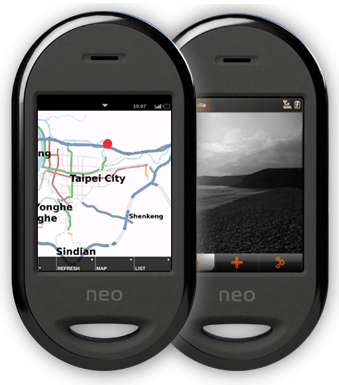
I recently got the chance to play with an OpenMoko Neo FreeRunner. It is a small linux computer made as a phone. With a touch screen and lots of fun hardware. GPS, WiFi, Motion sensors - and of course, mobile phone antenna.


However, my initial impression is that it is much more a toy than a phone. It can actually make phonecalls, but many things are wrong with the software that comes with it by default. It is slow, and misses programs for all the fun hardware. And this warning is really scary:

Can't boot with discharged or missing battery

Issue: Neo FreeRunner requires battery power to boot, because Neo FreeRunner consumes too much current while booting to boot with only a charger. Since charging isn't enabled until the Neo FreeRunner has booted, this means that a discharged battery can not be charged. One manifestation of this problem is a kernel panic (red LED flashes constantly) when trying to boot using the power button.

 
Fortunately the FreeRunner can be upgraded with a bit of effort. I'll try that soon. There is hope:  This guy is way ahead of me and seems to be enjoying his FreeRunner now.

Linus Torvalds reviews new flash based disk drives (SSD - solid state drive)

Here.

I want one too.

Friday, September 12, 2008

Mythbusters with helium and SF6

Lise and I are huge mythbusters fans. And incredibly, given our anemic TV channel selection, we have a channel that shows episodes quite frequently.

Here is a favorite clip

Sunday, August 24, 2008

Smart Energy Homes in Barcelona

I wonder where they will be built? Poble Nou? I missed the session about Smart Energy Homes at the ESOF in Barcelona.

http://www.guardian.co.uk/environment/2008/jul/21/greenbuilding.ethicalliving

Tuesday, August 05, 2008

Catholics and crackers

This post reminded me of mess in Denmark about offensive drawings of Muhammed.

And this post (with back-ground story) exactly mirrors my opinion on the drawings (although I think much, much better of PZ Myers than I do of Flemming Rose).

Sunday, July 20, 2008

Google docs - for web-polls

I just completed this questionaire - because all the cool kids are doing it. And I noticed that the poll was done with Google Docs. Cool! I haven't bothered to find out how, but I still find it cool. So, Google Docs, and doodle.ch has me covered with all the polling ability I can imagine needing.

Tuesday, July 08, 2008

PLoS and the future of publishing - as framed by Nature

There has been many good comments about the recent opinion pieces on PLoS from Nature employees (you can find the link via the comments - here is the second).

One perspective which has been overlooked a bit, as far as I can tell is that Nature has managed to frame the debate. Intentionally or not.

The framing can be summarized as "the problem is that top tier journals can't be profitable as open access - author pays, in competition with Toll-Access journals". This framing is advantageous to Nature as it implies that "the author-pays principle must generate all revenue for OA journals - subsidies are not ok". Equally advantageous is it when "top-tier journal" is defined not only as "high rejection-rates" but also "high overheads". Nature has an interest in making the two things seem inseparable.

For society and everyone who is not Nature (or other Toll-Access, high overhead journals) the framing does not make sense. The debate is part of a broader debate of the future of scientific publishing. And it is unreasonable to assume that a future of efficient digital publishing must be hobbled to serve to needs of businesses adapted to the past of high cost of paper distribution. Or that it must be measured by the same criteria of success (high profit from monopoly priviledges) as old businesses.

For society the question (obviously) is "how do we maximize society-gain from published research". There is no question that the enormous subsidy that is coorporation held monopoly priviledges via copyright can make publishing of popular content profitable for some publishers. But since this arrangement maximizes monopoly profit for select organizations and not gain for society, society should look at other arrangements. Other arrangements, which secure access also for those that value the access below the monopoly pricing but above the neglible cost of digital reproduction. And in no area of publishing is the fairness of society interference with current buisiness models larger than science, where the producers of content are mostly publically financed and the consumers also.

Among "other arrangements", one obvious extreme is lump subsidy and no access restrictions. This gives maximum society benefit at a fixed price.

Other arrangements are "some subsidy + other revenue" which is exactly the model that PLoS explores. And which should be explored. And which does not need to be successful by the same measures as Nature was successful in the past.

And as a personal opinion on this - I think that what will (and should) happen is that the market (lead by initiatives like PLoS) will drive costs of top-tier publishing down. Future top-tier publications will simply have to have unbundle, have less costly content, and less costly procedures - and will consequently look different from today. I see an obvious analogy to newspaper-publishing which was discussed at the Becker-Posner blog recently: Posner - Becker

And as Greg Laden relates, Nature supplied somewhat opaque answers to the UK parliament on Nature finances. But from those, to me, there seems to be plenty of costs to cut.

(Updated: fix link, clarify last sentence)